
Degree Verification Letter Translation: Confirming Awards, Dates, and Academic Status
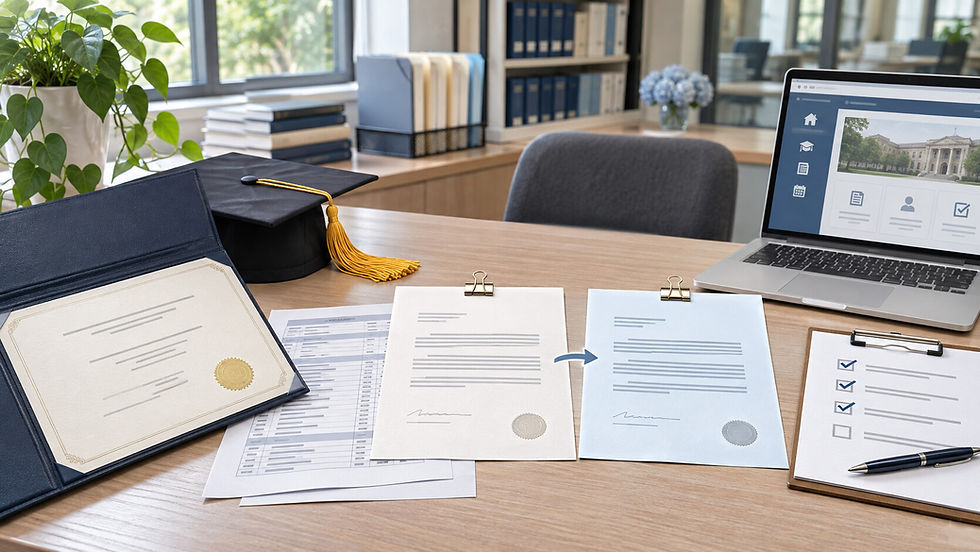
A degree verification letter is a concise statement from a university or authorized service confirming that a student received a particular academic award. Employers, universities, licensing boards, immigration authorities, scholarship programs, and background-check providers may request it when a diploma or transcript alone does not answer a specific question. If the letter is in another language, a careful degree verification letter translation should preserve the award title, institution, dates, student identity, academic status, signer, and verification method.
Short academic letters are easy to underestimate. A translation that changes "completed coursework" to "graduated" can overstate the record. Confusing the conferral date with the ceremony date can create a mismatch. Translating a local qualification as a familiar U.S. degree can imply an equivalency that the source does not establish.
This guide explains how to obtain the right letter, distinguish verification from evaluation, handle degree titles and dates, coordinate related academic documents, and review the translated record before submission.
What Is a Degree Verification Letter?
A degree verification letter, graduation confirmation, award letter, or registrar statement generally confirms one or more facts from the institution's official records.
It may include:
Student's legal name
Student or registration number
Institution and campus
Program or field of study
Qualification awarded
Attendance dates
Completion date
Conferral or award date
Graduation date
Enrollment status
Honors or classification
Language of instruction
Accreditation or authorization statement
Registrar or official's name and title
Signature, seal, QR code, or validation link
Issue date
The terminology varies. A letter confirming current enrollment is not necessarily a degree verification. A provisional completion letter may be issued before formal conferral. Preserve the exact purpose of the source.
Translation Is Not Credential Evaluation
Translation communicates the document in English. Credential evaluation compares a foreign qualification with an education system or level.
The U.S. Department of Education explains that it does not evaluate foreign credentials. Recognition decisions generally rest with employers, universities, licensing agencies, or immigration authorities, and those recipients may request a private credential evaluation. See the Department's foreign credential recognition FAQ.
A translated letter should not add:
A U.S. degree equivalent
A converted GPA
An accreditation conclusion
Transfer-credit value
Professional licensure eligibility
Employment eligibility
If the recipient wants both translation and evaluation, obtain separate instructions for each service.
That separation also protects the applicant. A faithful translation gives the decision-maker the same facts that appear in the source, while an evaluator applies its own published methodology. Keeping those roles distinct makes corrections, appeals, and recipient review easier to document.
When a Verification Letter Is Useful
Employment background check
An employer may need confirmation that the named person earned the stated degree on a particular date. The background-check provider may require direct institutional delivery.
Graduate admission
A university may request proof of award when the final diploma or transcript is delayed.
Professional licensing
A licensing board may require award confirmation, program dates, clinical hours, accreditation, or direct registrar contact.
Immigration filing
A petition or application may use academic evidence to document education. Counsel determines which record and evaluation are needed.
Scholarship or fellowship
The program may need degree status, completion date, honors, or current enrollment.
Personal record correction
A verification letter may explain a name change, delayed diploma, corrected award date, or institutional reorganization.
The recipient decides whether the letter is sufficient. Translation does not make an unofficial letter official.
Obtain the Correct Source
Request it from the registrar
Use the institution's official records office, digital credential service, or authorized verification provider.
Confirm the intended facts
Ask the recipient whether it needs degree awarded, attendance, enrollment, program completion, honors, or language of instruction.
Use the final issued version
A draft email from a department may not replace a signed registrar letter.
Preserve delivery requirements
Some recipients require the institution to send the record directly, use a sealed envelope, or provide a validation link. Translating a student-uploaded copy does not override those rules.
Save digital validation data
Keep QR codes, secure URLs, reference numbers, and expiration dates intact. Do not alter a verification code.
Include all pages and attachments
A second page may contain definitions, signature information, or validation instructions.
Student Names and Identifiers
Names may differ because of marriage, transliteration, compound surnames, abbreviations, or institutional formatting.
Provide the translator with:
Passport spelling
Current application spelling
Name used during enrollment
Prior names
Student number
Any official name-change document
The translation should preserve the source name and use established transliteration consistently. It should not silently replace the registrar's record.
If the letter includes a partial date of birth or masked identifier, reproduce it exactly. Do not expand masked digits.
Degree Names and Academic Titles
Preserve the official qualification
Translate the award title faithfully. If no safe English equivalent exists, retain the original title with a descriptive translation.
Do not create equivalency
A local first-cycle, specialist, licentiate, diploma, or professional title may not equal a U.S. bachelor's or master's degree.
Keep field of study separate
The qualification level and major are different data points.
Preserve honors and classifications
Terms such as distinction, first class, cum laude, or professional honors should be translated carefully and not converted to a GPA.
Use institutional references
An official bilingual diploma supplement or prior approved translation can help with terminology. The new source still controls.
Our diploma translation for employment guide explains how to avoid overstating foreign qualifications.
Dates That Must Stay Distinct
A verification letter may contain:
First attendance date
Last attendance date
Program completion date
Examination date
Degree conferral date
Graduation ceremony date
Letter issue date
Digital validation expiration date
Do not label the completion date as the award date unless the source does. Use unambiguous English dates and preserve the academic term when relevant.
If the transcript and letter show different dates, check whether one records completion and the other conferral. Do not edit the translation to force agreement.
Enrollment, Completion, and Conferral
These statuses are not synonymous.
Enrolled
The student is or was registered for study.
Completed requirements
The student may have finished coursework and examinations but not yet received formal approval or conferral.
Eligible to graduate
The student may satisfy conditions subject to final review.
Degree conferred
The institution formally awarded the qualification.
Graduated
The source may use this for formal award, ceremony participation, or program completion. Translate according to institutional context.
A careful translator preserves qualifiers such as "pending," "provisional," "subject to," and "expected."
Accreditation and Institutional Status
Accreditation language can be sensitive. The U.S. Department of Education explains that postsecondary accreditation in the United States is conducted by recognized nongovernmental accrediting organizations, not by the Department itself. See its college accreditation resources.
For a foreign institution:
Translate the source's accreditation or authorization statement
Preserve the named authority
Keep the effective dates
Do not add a U.S. recognition conclusion
Do not state that translation proves accreditation
The receiving institution, employer, licensing board, or evaluator decides how it recognizes the credential.
Signatures, Seals, and Digital Verification
Signature
Use a neutral notation such as "[signature]" and translate the printed name and official title.
Institutional seal
Translate readable text and describe the element. Do not recreate an English seal.
QR code
Identify the code without replacing it. If the source provides a validation instruction, translate that instruction.
Secure digital signature
Preserve the signer, date, certificate status, and transaction or validation identifier.
Email-issued letter
Save the full email header and attachment if delivery is part of authenticity. The translation scope should identify whether it covers the email, the letter, or both.
Related Academic Records
A recipient may also request:
Diploma
Transcript
Diploma supplement
Enrollment verification
Course descriptions
Syllabus
Grading scale
Professional license
Credential evaluation
The enrollment verification translation guide focuses on current or past student status. Our article on credential evaluation versus certified translation explains the separate functions.
Certified Translation and Recipient Rules
Ask whether the recipient requires:
Certified translation
Translator statement with contact details
Direct delivery
Sealed envelope
Original signature
Notarization
Electronic PDF
Institution-issued source
Credential evaluation
Deadline-specific format
A certified translation addresses accuracy and completeness. It does not authenticate the registrar's signature, validate the degree, or determine equivalency.
Step-by-Step Preparation
Obtain the recipient's current checklist.
Request the correct letter from the registrar.
Verify student name and award details.
Confirm all pages and validation instructions.
Provide established name spellings.
Include related academic records for reference.
State source and target languages.
Confirm certification and delivery rules.
Translate the complete letter.
Review names, qualification, dates, status, and signer.
Pair the translation with the source.
Submit through the required channel.
eGO Translate offers academic translation services for registrar letters, diplomas, transcripts, and supporting education records.
Need a university registrar letter translated for employment, admission, or licensing? Send the final official letter, recipient instructions, established name spelling, and deadline to eGO Translate for a precise quote.
Quality-Control Checklist
Verify:
Student name
Student number
Institution and campus
Program
Qualification title
Field of study
Attendance dates
Completion date
Conferral date
Graduation date
Honors or classification
Enrollment or award status
Qualifying words
Accreditation statement
Signer name and capacity
Seal and signature notation
Issue date
Validation code or link
Page count
Certification
Common Mistakes
Turning completion into conferral
Preserve the exact academic status.
Converting a degree title
Translation should not claim U.S. equivalency.
Using an unofficial screenshot
Request the final letter or authenticated digital record accepted by the recipient.
Omitting validation instructions
QR codes, reference numbers, and secure links can be essential.
Combining different dates
Attendance, completion, conferral, ceremony, and issue dates serve different purposes.
Assuming translation replaces evaluation
The recipient may need both services.
Frequently Asked Questions
Is a degree verification letter the same as a transcript?
No. A letter confirms selected facts. A transcript lists courses, grades, credits, and academic history.
Is it the same as a diploma?
No. A diploma is the award document. A verification letter is a statement from the institution's records.
Can the translation state the U.S. equivalent?
Not as part of a faithful translation unless the source states it. A credential evaluator addresses equivalency.
What if the degree has not been conferred?
Translate the current status exactly, including provisional or expected language.
Does the recipient need the original letter?
Possibly. Some require direct or sealed delivery. Confirm before ordering.
Is notarization required?
Only if the recipient requires it. Certification, notarization, authentication, and evaluation are distinct.
Can a digital verification letter be translated?
Yes. Preserve the validation method, code, URL, signature, and expiration information.
How long does translation take?
Turnaround depends on length, language, seals, validation content, formatting, certification, and delivery. Send the complete source for an accurate estimate.
Confirm the Award Without Overstating It
A reliable degree verification letter translation preserves the institution's exact statement about identity, award, dates, and academic status. It distinguishes enrollment, completion, conferral, and graduation and avoids creating a credential equivalency that the source never claimed.
Use the official final letter, follow the recipient's delivery rules, and review every name, qualification, date, and qualifier. The result will be easier for an employer, university, board, or evaluator to verify.


